A crypto market scanner is a discovery tool
A lot of traders hear the word scanner and imagine a magic signal machine. That is the wrong mental model.
A crypto market scanner is not there to tell you what to buy. It is there to watch more markets than you can manually watch, apply conditions consistently, and surface the markets that deserve attention next.
That makes it a discovery tool. In practice, the real question is not whether a scanner can replace charts. It is whether a scanner can reduce the amount of manual searching you need to do before analysis even begins.
For a lot of traders, that is the real bottleneck. They are not bad at reading charts. They are slow at discovering where to look.
What a crypto market scanner actually does
A useful crypto market scanner usually does four things.
- Watches many markets at once instead of forcing you to check coin after coin manually.
- Applies rule-based conditions so the process is less emotional and more consistent.
- Surfaces candidates for review by narrowing a large market into a smaller list worth inspecting.
- Supports a repeatable workflow you can test, review, and improve over time.
When a watchlist is enough
Watchlists are still useful. They are just useful for a different job.
A watchlist is often enough when you trade a small fixed group of coins, you are already managing known positions, your edge comes from deep familiarity with a narrow set of names, or you want a low-noise dashboard rather than broad discovery.
That is why watchlists stay popular. They are simple, they feel controlled, and they reduce clutter. If you already know the few markets that matter to you, a watchlist may be all you need.
The problem starts when traders expect a watchlist to solve discovery. It usually cannot.
When a scanner is better than a watchlist
A scanner becomes more useful when the question changes from “How do I keep an eye on these coins?” into “How do I find the next market worth checking?”
That is where the difference becomes practical. A scanner is usually better when you do not know where the next move will begin, you want broader market coverage without living in charts all day, you want rules to surface candidates before manual review, or you are missing moves because your workflow starts too narrow.
This is the discovery gap. A watchlist reflects what you already know. A scanner helps you search beyond that. That does not make the scanner smarter. It just makes it better suited to the discovery job.
Scanner vs watchlist vs charting platform
These tools overlap, but they are not the same. A watchlist is best for focus on a known set of markets. A scanner is best for surfacing markets that match your conditions. A charting platform is best for validating setups, comparing structure, and inspecting detail.
The strongest workflow is often not pick one forever. It is: use a scanner for discovery, use charts for validation, then use a watchlist for markets that still deserve ongoing attention.
That sequence is usually more useful than trying to make one tool do every job.
If discovery feels too manual
A scanner works best when it improves the first step of the workflow. Start broad, narrow with rules, validate in TEST mode, and only move closer to LIVE use once the process makes sense.
A simple example
Imagine two traders using the same exchange.
A watchlist-first trader follows 12 familiar coins, sets alerts on those names, checks charts repeatedly, and reacts when one of those markets starts moving.
A scanner-first trader monitors a broader set of markets, uses conditions to surface candidates, reviews only the markets that pass the filters, and adds the strongest candidates to a temporary watchlist for closer analysis.
The watchlist-first workflow may feel more organised. The scanner-first workflow is more likely to discover a relevant setup before it becomes obvious on the same familiar names.
Common mistakes when using a scanner
A scanner can improve the first step of the process, but it can also create noise if used badly.
- Treating scanner output like a trade signal instead of a candidate list.
- Scanning too broadly with vague rules, which creates broader noise rather than better discovery.
- Skipping validation after a market is surfaced.
- Confusing more alerts with more edge.
How to choose a crypto market scanner
If you are evaluating scanners, the practical questions are simple.
- How broad is the coverage?
- How flexible are the conditions?
- Can you test the workflow safely before using real money?
- Can you review what happened and understand what fired?
- What is the trust model for execution, API keys, and workflow visibility?
Where PriceWatch fits
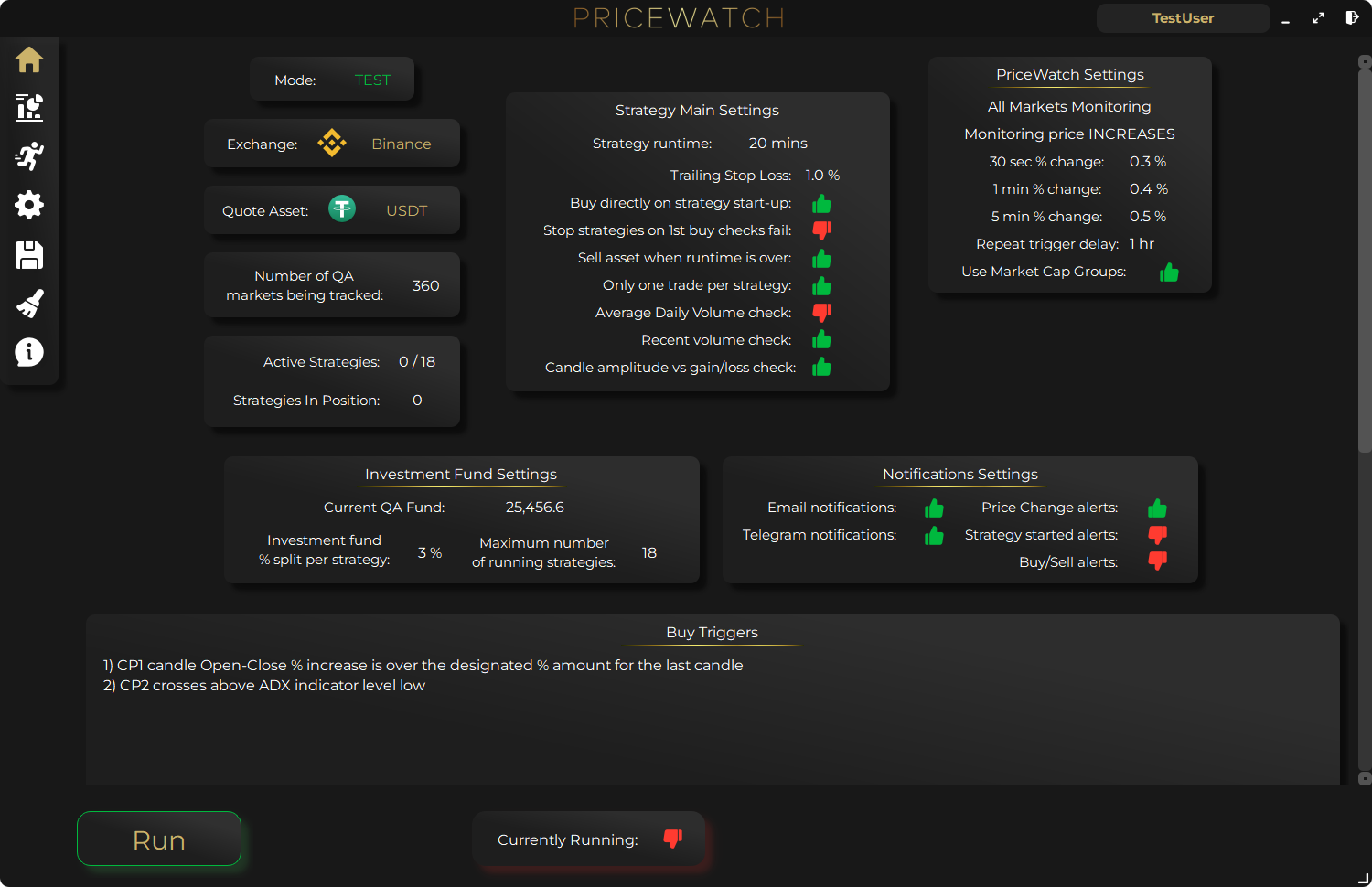
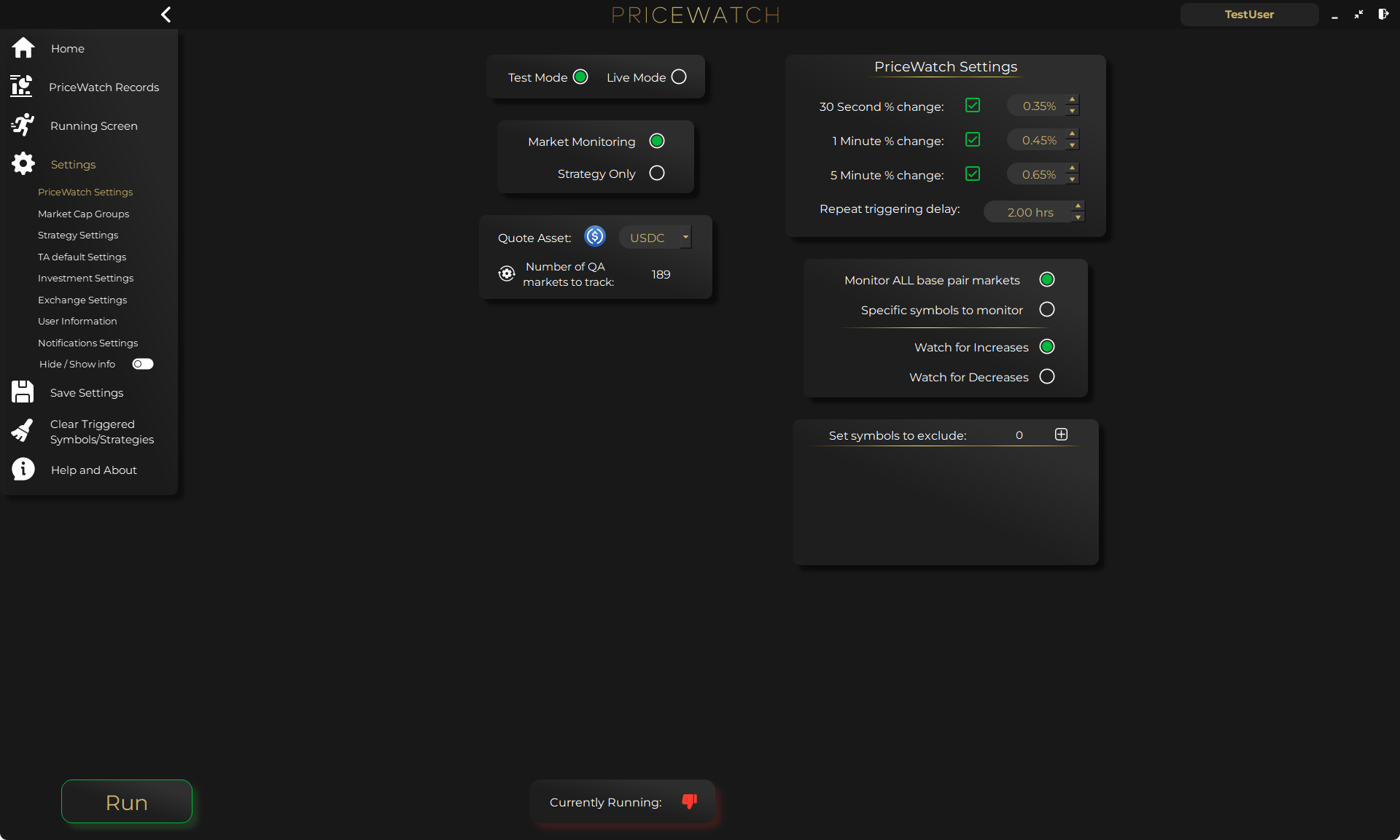
PriceWatch is built around broader market monitoring and workflow validation rather than a small manual watchlist alone.
Based on the current product documentation, PriceWatch is a desktop cryptocurrency market monitoring and automated trading application that runs locally on the user’s Windows machine.
The current product materials also describe support for 15 exchanges, coverage across 25,000+ trading pairs, 7,500+ indicator trigger combinations across three candlestick timeframe periods, market data gathered every 5 seconds and live price triggers checked every 15 seconds, TEST Mode for validating workflows before moving to LIVE use, and Live Feed visibility with downloadable logs.
Those details matter because a scanner is only useful if it helps you build a repeatable process: monitor broadly, surface candidates with rules, review what triggered, validate in TEST mode first, and move closer to LIVE use only after the workflow makes sense.
So, is a crypto market scanner better than a watchlist?
Sometimes yes. Sometimes no.
A scanner is better when the main problem is discovery. A watchlist is better when the main problem is focus. That is the simplest way to think about it.
If you already know exactly which markets matter, a watchlist may be enough. If you keep missing moves because your process starts too narrow, a scanner is usually the more useful tool.
The real win is knowing which job you are trying to solve.
Want to see the workflow in practice?
Start by reviewing the workflow in TEST mode
PriceWatch runs locally, helps you monitor broader markets, and gives you a way to review how the workflow behaves before deciding whether moving closer to LIVE use makes sense for you.
Prefer to keep researching first?
Keep learning before you decide
Get practical workflow ideas, product updates, and new articles by email, or keep reading through the blog at your own pace before you take the next step.
Keep the route moving
Best next pages from here
If this article solved only part of the problem, use the closest route below to keep moving through discovery, alerting, trust, and comparison intent without bouncing back to search.
Discovery route
Crypto market scanner
Use the fixed-intent landing page if you want the clearest explanation of scan-first market discovery.
Alerting route
Desktop crypto price tracker
Go here if your main intent is Windows-based monitoring, price alerts, and local desktop workflow.
Trust route
Cloud bot vs local software
Use this when the next question is privacy, key control, and where the workflow actually runs.
Comparison route
PriceWatch vs TradingView
Use the comparison path if you are weighing chart-first analysis against discovery-first monitoring.
Who this is for (and who it is not for)
Good fit if
- You want broader crypto market coverage instead of checking the same small set of charts over and over.
- You want a more repeatable discovery workflow before manual analysis begins.
- You like the idea of testing a process before trusting it with real money.
Not a fit if
- You only trade a tiny fixed list of markets and do not want broader discovery.
- You prefer fully manual chart review for discovery and do not want defined filters.
- You are looking for a shortcut to good trading decisions instead of a better process.
FAQ
Is a crypto market scanner the same as a trading bot?
No. A scanner is mainly for discovery. A trading bot is mainly for execution. Some products combine parts of both, but the jobs are still different.
Is a scanner better than a watchlist?
It is better for discovery. A watchlist is better for staying focused on markets you already chose.
Can beginners use a crypto market scanner?
Yes, but beginners should treat it as a way to narrow the market, not as a shortcut to good trading decisions.
Do you still need charts if you use a scanner?
Usually yes. A scanner helps you find candidates. Charts still help with validation and context.
What should I test first if I am new to scanners?
Start with one exchange, one clear market focus, simple conditions, and a TEST-first workflow before risking real money.