The real difference is discovery, not convenience
Most traders talk about watchlists as if they are the default way to stay organised.
That is true, but incomplete.
A watchlist is mainly a focus tool. It is useful when you already know what you want to watch. It is much weaker as a discovery system, because it cannot surface what never made it onto the list in the first place.
That is the practical reason whole-market monitoring matters.
It changes the first step of the workflow from “Which coins should I watch today?” into “Which markets currently match the conditions I care about?”
What a watchlist is good at
Watchlists are not bad. In the right context, they are useful.
A watchlist is usually enough when you only trade a small set of familiar markets, your strategy is built around a few specific names, you want a clean low-noise dashboard, or you prefer manual review over broader scanning.
The problem starts when traders expect a watchlist to also solve discovery. It usually does not.
Why watchlists miss crypto opportunities
A watchlist reflects what you already know, what you already suspect, or what you last cared about.
That creates three practical problems: familiar-name bias, manual discovery drag, and late reactions.
This is the discovery gap. The gap is not between analysis and execution. It is between what the market is doing and what your workflow is actually watching.
- You keep spending attention on the same names, even when better setups may be elsewhere.
- To expand beyond the list, you still need to manually search, scroll, and compare other markets.
- By the time a move feels obvious enough to add to the watchlist, the best part of the setup may already be gone.
What whole-market monitoring changes
Whole-market monitoring does not mean watching everything with no structure.
It means the software does the hard part of checking more markets than a manual watchlist can realistically cover, then narrows attention based on rules you define.
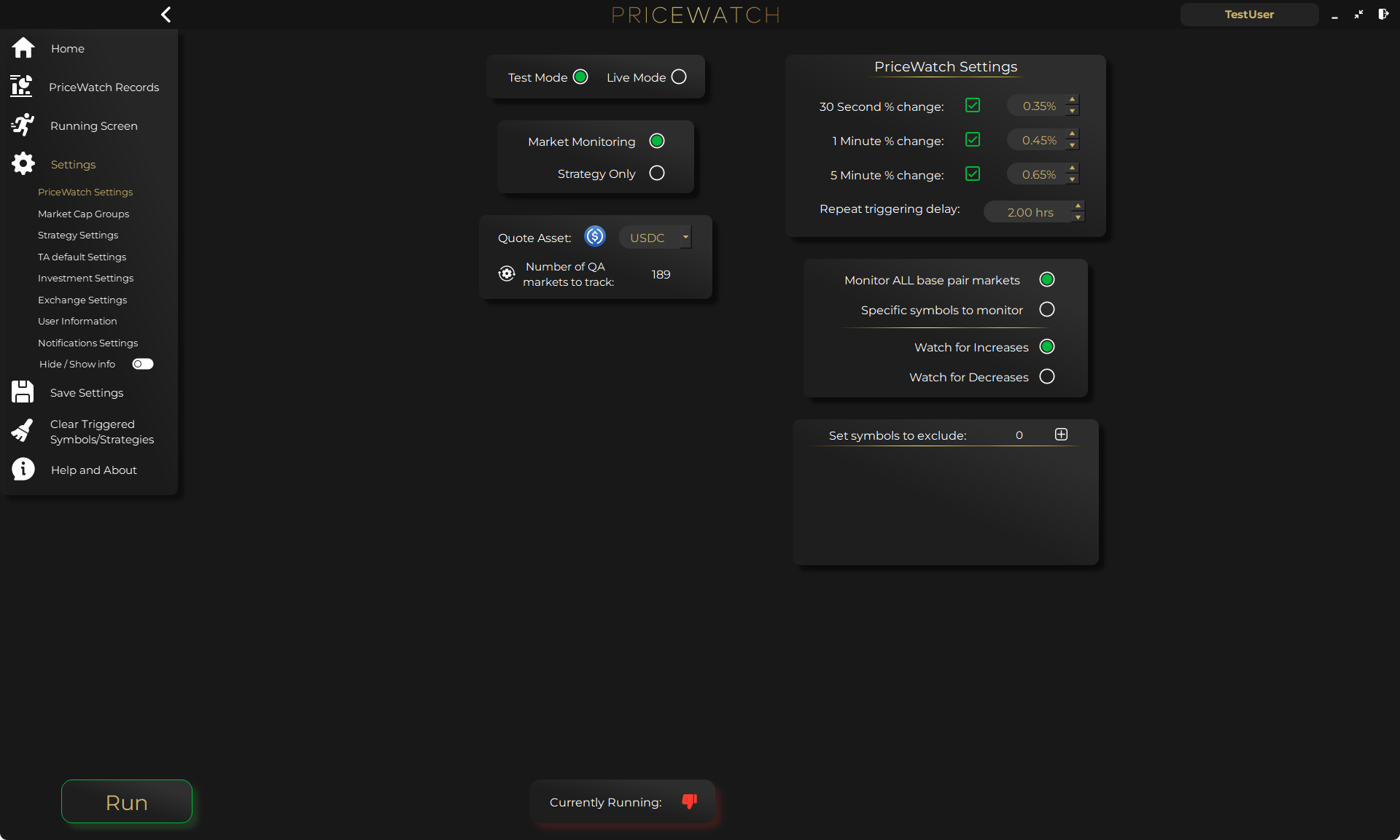
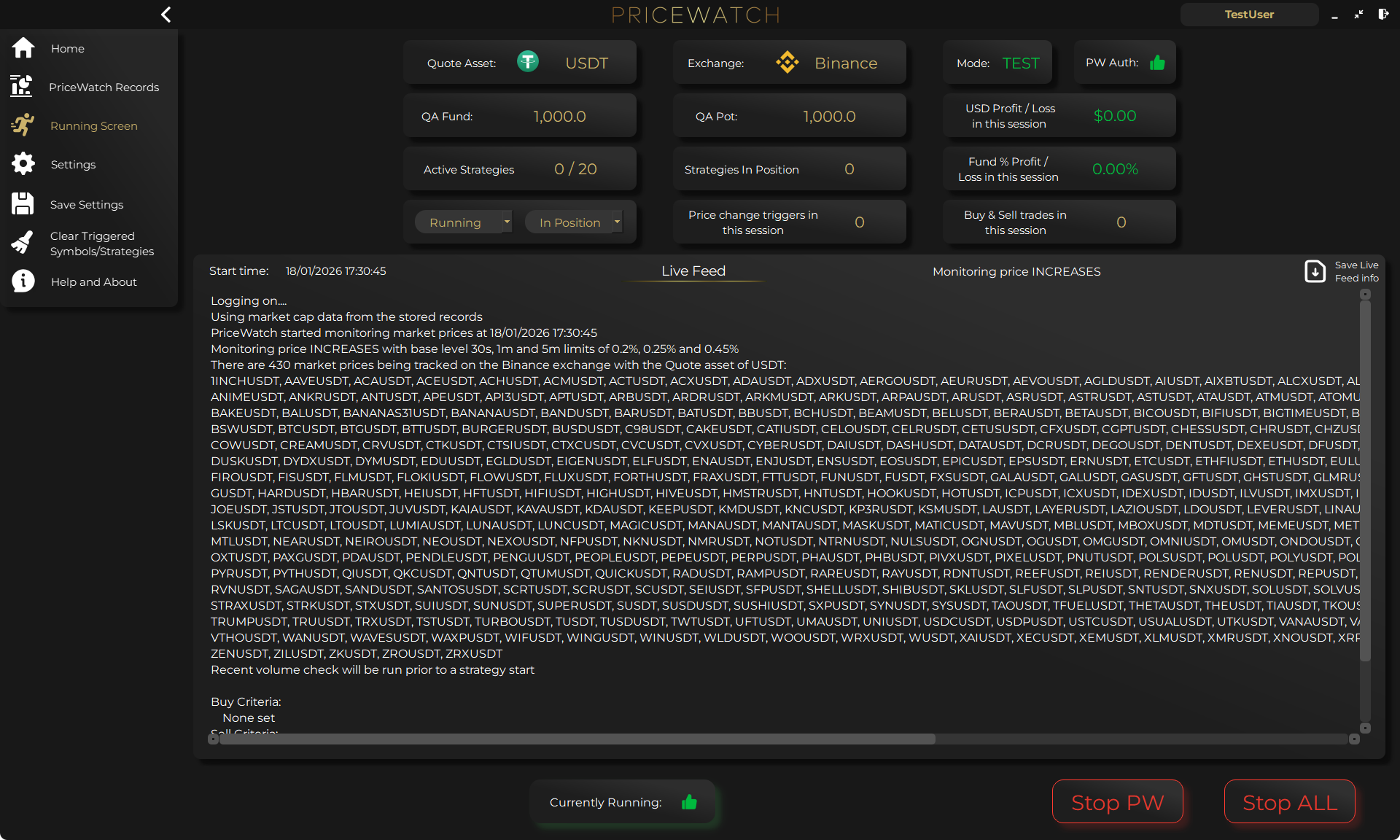
In PriceWatch documentation, this is described as a workflow that can monitor all available markets for a chosen quote asset on a selected exchange, rather than relying on a manual coin list first.
Broader monitoring changes the order of operations: monitor broadly, surface candidates that match your conditions, validate them with tighter rules, then decide whether they are worth acting on.
A practical example
Imagine two traders using the same exchange.
A watchlist-first trader watches 15 familiar coins, sets alerts on those coins, checks charts repeatedly, and reacts when one of those names starts moving.
A broader-monitoring trader monitors the relevant market universe for one quote asset, uses trigger logic to surface candidates, reviews only the markets that meet the conditions, and starts in TEST mode before trusting the workflow in LIVE mode.
The watchlist-first workflow feels simpler. The scan-first workflow is usually better for discovery.
If discovery feels too manual
Try a broader monitoring workflow in TEST mode first. The goal is not to watch everything forever, it is to surface better candidates earlier, then narrow down with rules you can explain clearly.
When each approach is enough
Use a watchlist-first workflow if you trade a fixed, small set of markets, your edge depends on deep familiarity with those names, and you accept that discovery will be narrower.
Use broader monitoring if you want to discover opportunities beyond a hand-picked list, you are missing moves because discovery is too manual, and you want rules to surface candidates for review.
If you are specifically weighing a chart-first tool against a broader discovery workflow, the PriceWatch vs TradingView comparison page is the cleanest next step.
This is not about one method being smart and the other wrong. It is about matching the workflow to the job.
The best workflow is usually broad first, narrow second
The most practical setup is often not only watchlists or watching absolutely everything.
A stronger workflow is broad monitoring for discovery, tight rules for filtering, and manual judgment or further validation before execution.
Broader monitoring without discipline creates noise. Narrow monitoring without discovery creates blind spots.
Where PriceWatch fits
PriceWatch is built around broader market monitoring and rule-based automation, not just a small manual watchlist.
Based on current product materials, PriceWatch is a desktop crypto market monitoring and automated trading application that runs locally on the user’s own Windows machine.
The product materials also describe support for 15 exchanges, monitoring of 25,000+ trading pairs, over 7,500 indicator trigger combinations, and TEST mode for validating ideas before LIVE use.
That makes the watchlist versus whole-market question a workflow decision, not just a feature preference.
Want to see the workflow in practice?
Start by reviewing the workflow in TEST mode
PriceWatch runs locally, helps you monitor broader markets, and gives you a way to review how the workflow behaves before deciding whether moving closer to LIVE use makes sense for you.
Prefer to keep researching first?
Keep learning before you decide
Get practical workflow ideas, product updates, and new articles by email, or keep reading through the blog at your own pace before you take the next step.
Keep the route moving
Best next pages from here
If this article solved only part of the problem, use the closest route below to keep moving through discovery, alerting, trust, and comparison intent without bouncing back to search.
Discovery route
Crypto market scanner
Use the fixed-intent landing page if you want the clearest explanation of scan-first market discovery.
Alerting route
Desktop crypto price tracker
Go here if your main intent is Windows-based monitoring, price alerts, and local desktop workflow.
Trust route
Cloud bot vs local software
Use this when the next question is privacy, key control, and where the workflow actually runs.
Comparison route
PriceWatch vs TradingView
Use the comparison path if you are weighing chart-first analysis against discovery-first monitoring.
Who this is for (and who it is not for)
Good fit if
- You feel like your workflow is too dependent on repeatedly checking the same familiar names.
- You want broader crypto market discovery without living in charts all day.
- You want to understand whether a scanner-style workflow fits you better than a watchlist-first workflow.
Not a fit if
- You only ever trade a tiny fixed set of markets and do not want broader discovery.
- You are looking for guaranteed outcomes rather than a better process.
- You do not want to define rules before expanding your monitoring scope.
FAQ
What is the difference between a watchlist and a market scanner?
A watchlist is a list of markets you already chose to follow. A market scanner or whole-market monitoring workflow is designed to search a larger market universe and surface candidates that match defined conditions.
Are watchlists bad for crypto trading?
No. Watchlists are useful for focus and routine tracking. They become limiting when you expect them to solve discovery across a fast-moving market.
Why do traders miss moves with watchlists?
Because a watchlist can only show the markets already on the list. If a strong setup starts elsewhere, discovery stays manual and often happens later.
Is whole-market monitoring too noisy?
It can be, if it is not paired with clear filters and validation rules. Broad monitoring works best when discovery is wide but decision rules stay narrow.
How should a beginner test this safely?
Start small. Use one exchange, one clear market focus, and a simple rule set. Validate the workflow in TEST mode first before you trust it in LIVE trading.