
Quick answer
Many traders make the same mistake at the start. They try to make the first TEST Mode strategy do too much at once, then wonder why the results are hard to read.
A better first setup is much calmer. It should monitor for one kind of behaviour, surface candidates clearly enough to review, and teach you whether the workflow is useful or just noisy.
What a good first strategy should do
A first strategy should not try to impress you. It should make sense. You should be able to explain what kind of behaviour it is trying to find, why that matters, and what useful output would look like.
If the setup is too complicated to explain clearly, it is usually too complicated for a first TEST cycle.
Start with one simple job
The safest first strategy is built around one clear job, not five jobs and not a giant theory of the market. You are trying to build one workflow you can actually understand.
That job might be surfacing unusual movement worth reviewing, focusing on a narrower section of the market, or helping you compare stronger versus weaker candidates more consistently.
A minimum viable TEST strategy
Before you switch anything on, define a minimum viable strategy you could explain on a note beside your screen.
- Goal: what kind of move or behaviour are you trying to surface?
- Filter: what is the simplest rule that stops the process becoming random noise?
- Expected output volume: could you review roughly 5 to 15 surfaced names, or about 15 to 20 minutes of output, without feeling rushed?
- Review note format: what one sentence would you write when a candidate feels strong, weak, or unclear?
Why simpler strategies teach you more
A lot of traders assume more conditions create more quality. Sometimes they just create more ways to misunderstand what is happening.
If the first TEST workflow is too dense, you cannot easily tell which part is helping, which part is too loose, and which part is filtering too aggressively. Simpler setups give cleaner feedback.
How PriceWatch handles this in practice
If you want the first strategy to stay grounded in the actual software, build it around the PriceWatch workflow instead of around abstract trading theory.
- Choose TEST Mode so you can learn on real market data without adding real-funds pressure.
- Use Market Monitoring if you want discovery across the markets for your selected quote asset on the selected exchange, or Strategy Only only if you already have one named market you want to test directly.
- Choose the exchange and quote asset you actually want to test, then keep the monitored set reviewable.
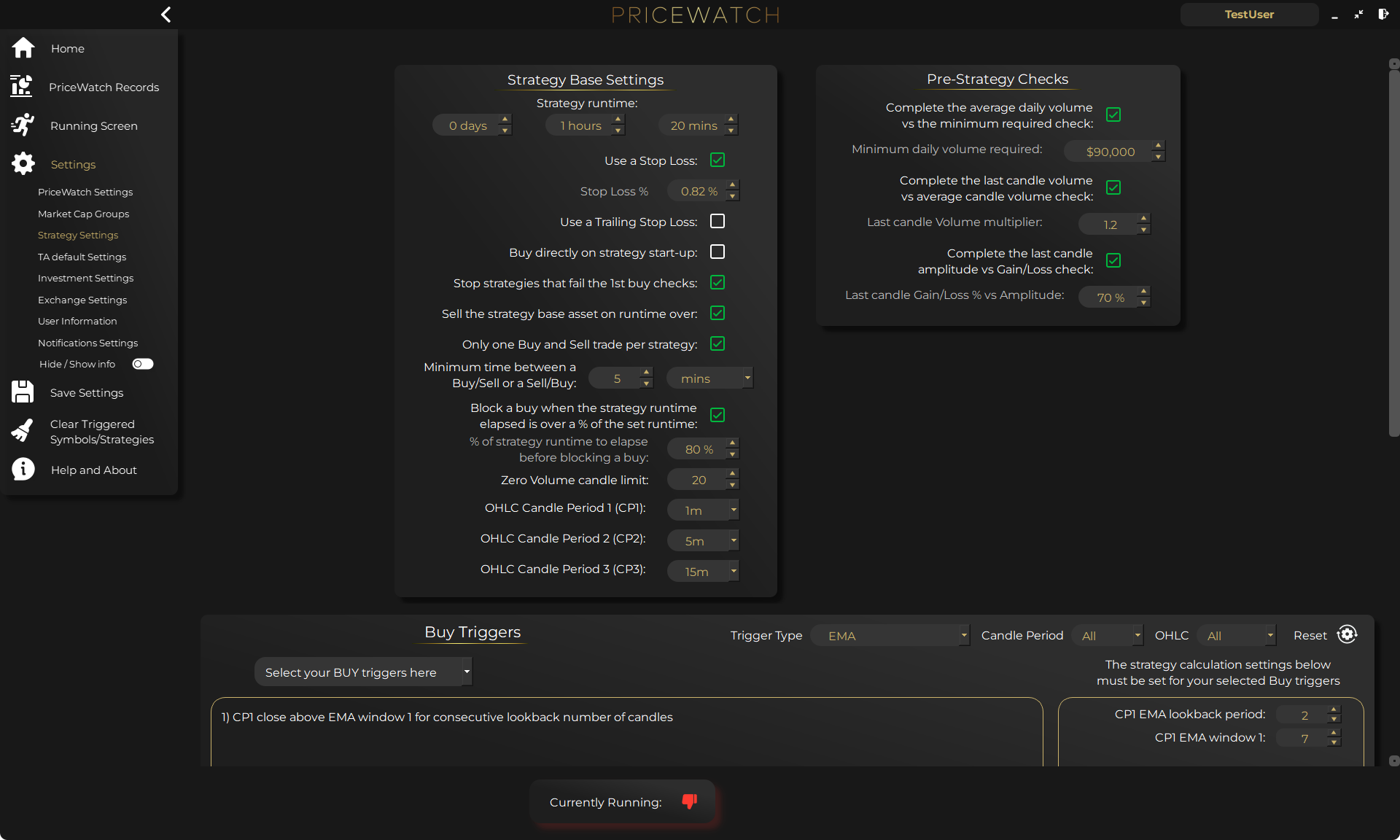
- Set all three price-change triggers so you do not miss moves that show up on different windows, then keep the rest of the workflow simple (avoid piling on extra filters at the start).
- Add at most one or two pre-strategy checks, such as Average Daily Volume, Candle Volume Multiplier, or Open-Close vs High-Low Ratio.
- Review what reaches the Live Feed, then review the TEST results again later in the Records Screen.
Start with one job, not a grand theory
If the first TEST workflow is easy to explain and calm to review, you will learn faster. Complexity can wait until the basic process makes sense.
Three useful starter templates
You do not need to invent the first TEST strategy from scratch. A small template is often enough to start learning honestly.
- Broad unusual-movement scan: set all three price-change triggers (wider coverage), then add one recent-activity filter.
- Cleaner movement only: start broad, then add a gain-loss-versus-amplitude check to reduce wick-heavy noise.
- Narrower market slice: keep the same trigger logic, but reduce the monitored universe so review stays calm.
Common mistakes in a first TEST cycle
The biggest mistakes are starting too complex, changing too many things at once, treating activity like proof, and building toward LIVE too early.
A first TEST strategy is not supposed to prove readiness. It is supposed to teach you how the workflow behaves.
What good early feedback looks like
The first strategy is probably helping if you can explain what it is trying to surface, the output feels interpretable rather than random, and your review notes are getting clearer instead of more confused.
That does not mean the strategy is finished. It means the learning loop is working, which is the real first win.
The real goal is clarity, not complexity
A lot of traders overbuild because complexity feels safer. Usually clarity is safer.
Your first TEST Mode strategy should leave you more able to explain the workflow, not less. Once that learning loop is clear, you can always add more sophistication later.
Want to see the workflow in practice?
Start by reviewing the workflow in TEST mode
PriceWatch runs locally, helps you monitor broader markets, and gives you a way to review how the workflow behaves before deciding whether moving closer to LIVE use makes sense for you.
Prefer to keep researching first?
Keep learning before you decide
Get practical workflow ideas, product updates, and new articles by email, or keep reading through the blog at your own pace before you take the next step.
Keep the route moving
Best next pages from here
If this article solved only part of the problem, use the closest route below to keep moving through discovery, alerting, trust, and comparison intent without bouncing back to search.
Discovery route
Crypto market scanner
Use the fixed-intent landing page if you want the clearest explanation of scan-first market discovery.
Alerting route
Desktop crypto price tracker
Go here if your main intent is Windows-based monitoring, price alerts, and local desktop workflow.
Trust route
Cloud bot vs local software
Use this when the next question is privacy, key control, and where the workflow actually runs.
Comparison route
PriceWatch vs TradingView
Use the comparison path if you are weighing chart-first analysis against discovery-first monitoring.
Who this is for (and who it is not for)
Good fit if
- You want a first TEST Mode setup that feels understandable instead of overwhelming.
- You want to learn from real candidate flow before thinking about LIVE Mode.
- You want a first strategy tied to what PriceWatch actually lets you configure and review.
Not a fit if
- You want your first setup to automate everything at once.
- You want activity to feel impressive even if the output is hard to interpret.
- You want LIVE pressure to create confidence you have not earned yet.
FAQ
What should my first TEST Mode strategy try to do?
It should do one clear job well, such as surfacing one kind of market behaviour worth reviewing. The first version should be easy to explain and easy to judge.
Should a first TEST Mode strategy be simple or advanced?
Simple is usually better. Complexity makes early testing harder because it becomes unclear which parts are helping and which parts are just creating noise.
How do I know if my first TEST strategy is too noisy?
If too many surfaced candidates feel weak, random, or hard to interpret during review, the setup probably needs tightening.
How often should I change the strategy while testing?
Avoid changing too many things at once. Smaller, clearer adjustments make it much easier to understand what actually improved the output.
Is the goal to move to LIVE as fast as possible?
No. The goal is to learn whether the workflow makes sense. LIVE Mode should come later, once the strategy feels understandable and reviewable.