Quick answer
Many traders assume the fix is more screen time. More tabs, more indicators, more checking. Usually that is the wrong fix.
If you are living in charts all day, the real problem is often not discipline. It is workflow design. You are probably doing too much manual discovery.
Use a simple framework: Broad -> Surface -> Review -> Validate
A stronger process looks different. Monitor more of the market, surface unusual movement earlier, review a smaller set of candidates that already earned attention, and spend serious chart time only where it actually matters.
You are not trying to stare harder. You are trying to start the review process later, with better raw material.
- Broad: let your monitoring cover more than your memory does
- Surface: let unusual movement narrow the field
- Review: do proper chart review only on candidates that already earned attention
- Validate: judge those candidates against your own rules
Why traders get stuck in chart overload
A lot of market fatigue starts with a narrow starting point. You keep a shortlist of coins you already know, rotate through charts looking for something interesting, and if a move starts outside that shortlist, you often see it later than you wanted to.
That creates two problems at once. It wastes attention on markets that may not deserve it, and it gives you poor coverage of the markets that might deserve it most.
The real problem is coverage, not effort
Most traders do not need more willingness to work. They already spend too much time checking charts. What they usually need is a better way to decide which markets are worth proper review at all.
Manual monitoring starts with what you already know and keeps checking until something looks active. Broad discovery watches more of the market, lets the market show what changed first, and zooms in only after something earns attention.
What unusual movement can mean in practice
You do not need a mystical definition here. Keep it practical. Unusual movement might mean a larger-than-normal range move, a relative volume spike, a clean break from recent chop, or a move strong enough to trip the price-change thresholds you already care about.
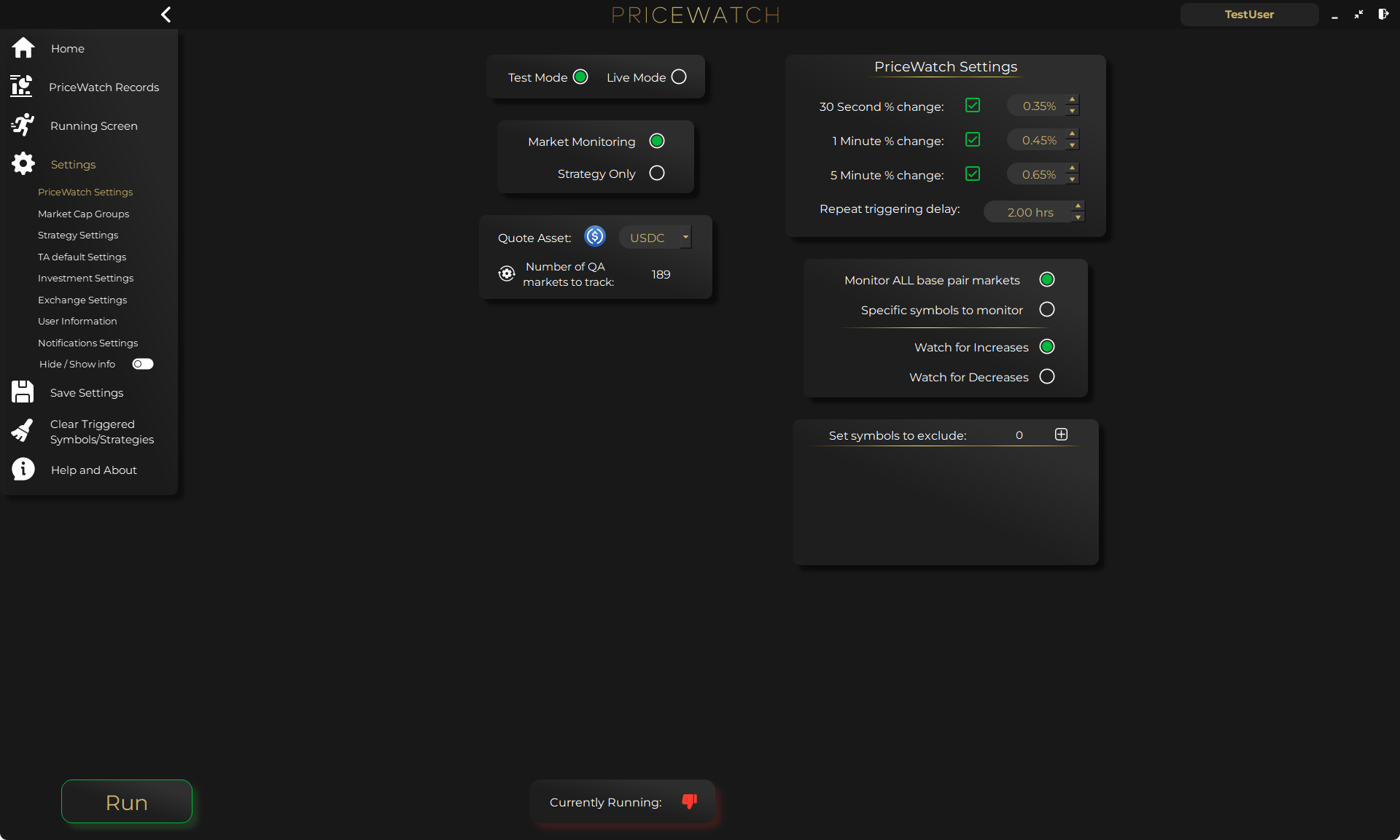
In PriceWatch, that can line up with 30-second, 1-minute, or 5-minute percentage-change triggers, a last-candle volume multiplier check, or a gain-loss-versus-amplitude check used to filter out low-quality wick-heavy moves.
What better market monitoring actually looks like
A watchlist is useful, but it is memory, not discovery. If your process begins with a shortlist, you only discover opportunities inside that shortlist. That works when the move begins where you expected. It breaks when it begins somewhere else.
In PriceWatch, broad monitoring can be as simple as using Market Monitoring across selected quote-asset markets instead of checking a narrow manual list one by one. But you are not forced into all-or-nothing monitoring. You can use selected markets when you want tighter focus, and exclusions when there are coins or tokens you want kept out before they create noise.
- broad monitoring when you want discovery
- selected markets when you want tighter focus
- an exclusion list when there are markets you do not want monitored at all
Do in-depth chart review in a dedicated charting tool
PriceWatch is useful for broad monitoring, workflow setup, TEST Mode validation, and strategy operations. It is not the place to pretend every market-wide chart review should happen.
If a surfaced market deserves a proper chart read, most traders are better off doing that in a dedicated charting environment, such as TradingView, the chart tools inside the exchange they trade on, or any other independent setup they already trust for deeper review.
If broad monitoring still feels messy
Start in TEST Mode, keep the first setup simple, and tighten only one part at a time. The goal is not more activity. It is clearer candidate flow.
Use PriceWatch charts for strategy context, not full market-wide review
There is one important nuance. PriceWatch can show candlestick charts for markets where a strategy is actually running. That is useful when you want to see where trades were made on the chart and how a live or TEST workflow behaved.
That is not the same thing as using PriceWatch as your main tool for broad, in-depth chart review across the market. Think of it as workflow context, not chart-first market analysis.
How PriceWatch handles this in practice
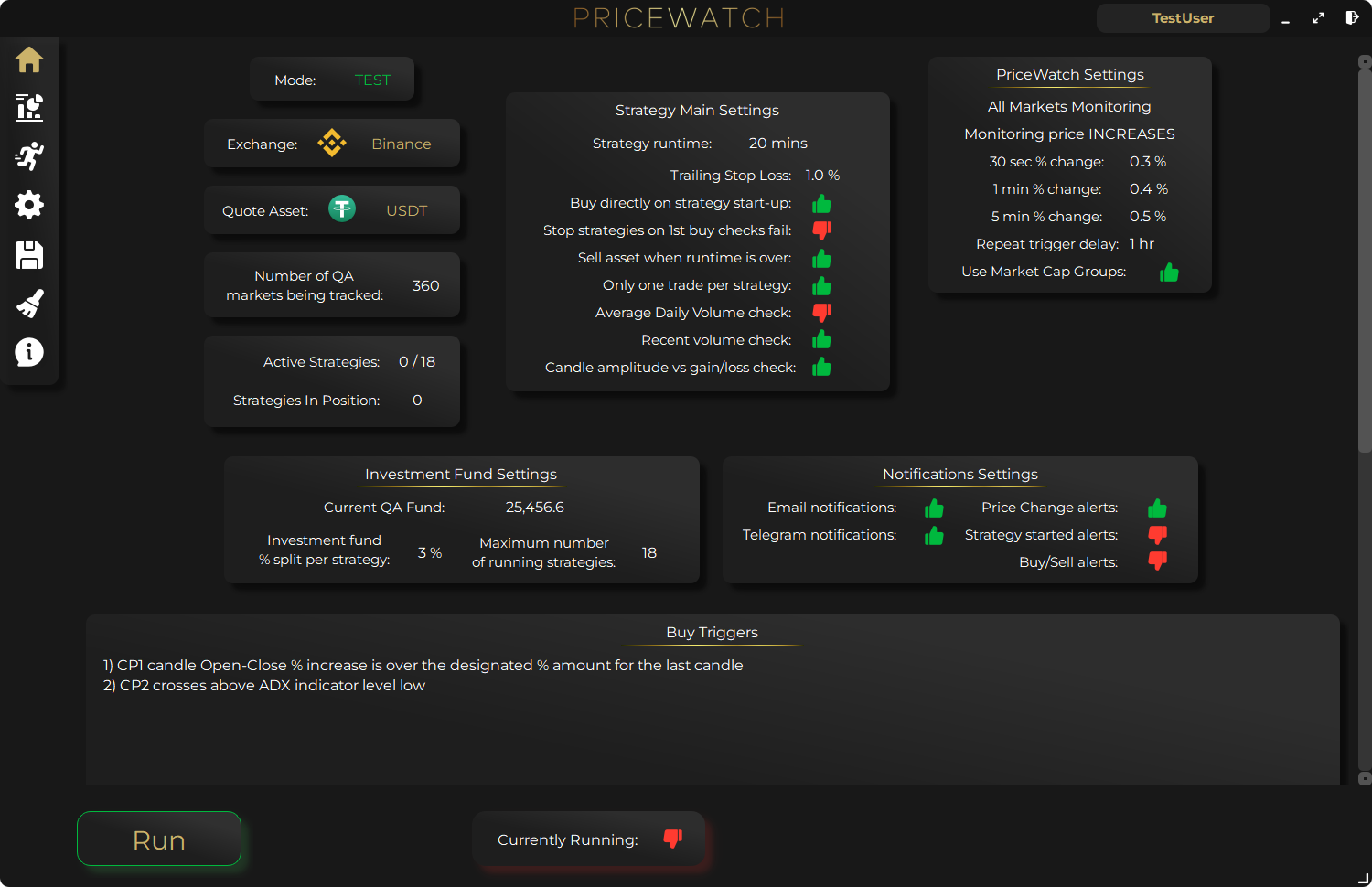
If you want this idea grounded in the actual software, keep the first workflow simple and stay in TEST Mode while shaping it.
- Choose Market Monitoring rather than Strategy Only if the goal is broad discovery.
- Choose the exchange and quote asset you actually want to monitor.
- Decide whether to monitor all markets for that selected quote asset on the selected exchange, or use a selected-markets list for a narrower slice.
- Use exclusions if there are markets you already know you do not want in the review flow.
- Set the price-change windows you care about, such as the documented 30-second, 1-minute, or 5-minute triggers.
- Use pre-strategy validation checks, such as Candle Volume Multiplier or Open-Close vs High-Low Ratio, to reduce low-quality surfaced moves before they steal your attention.
- Use the Live Feed and Records Screen to review what PriceWatch surfaced and what your workflows actually did.
- When a candidate still looks interesting, move to your preferred dedicated charting tool for deeper review before making bigger decisions.
Good candidate versus weak candidate
A broader workflow still needs a review standard. A good candidate clearly fits the kind of move you were trying to surface, stands out enough to justify in-depth chart review, and gives you a clear next step.
A weak candidate only looks active in the loosest sense, does not stand out against the background noise, and makes you spend time explaining why it might matter.
Common mistakes that keep traders glued to charts
More chart time does not automatically create more control. Sometimes it just creates more noise. A bigger watchlist can help a bit, but it is still a fixed universe, and a fixed universe still leaves the discovery problem in place.
Another mistake is doing deep chart review too early. If every surfaced market immediately gets a full chart session, broad monitoring loses its advantage. Better monitoring does not remove judgment. It improves the quality of the candidates reaching that decision point.
The real benefit is not just time saved
The obvious benefit is less chart fatigue, but the deeper benefit is process quality. When your workflow starts with broader discovery, you usually get cleaner candidate selection, less emotional attachment to a narrow shortlist, less pressure to predict where the move will start, and more consistent review conditions.
That is why better monitoring often leads to better decision-making. Not because the software decides for you, but because it improves the moment where your judgment begins.
Want to see the workflow in practice?
Start by reviewing the workflow in TEST mode
PriceWatch runs locally, helps you monitor broader markets, and gives you a way to review how the workflow behaves before deciding whether moving closer to LIVE use makes sense for you.
Prefer to keep researching first?
Keep learning before you decide
Get practical workflow ideas, product updates, and new articles by email, or keep reading through the blog at your own pace before you take the next step.
Keep the route moving
Best next pages from here
If this article solved only part of the problem, use the closest route below to keep moving through discovery, alerting, trust, and comparison intent without bouncing back to search.
Discovery route
Crypto market scanner
Use the fixed-intent landing page if you want the clearest explanation of scan-first market discovery.
Alerting route
Desktop crypto price tracker
Go here if your main intent is Windows-based monitoring, price alerts, and local desktop workflow.
Trust route
Cloud bot vs local software
Use this when the next question is privacy, key control, and where the workflow actually runs.
Comparison route
PriceWatch vs TradingView
Use the comparison path if you are weighing chart-first analysis against discovery-first monitoring.
Who this is for (and who it is not for)
Good fit if
- You feel like your process depends too heavily on a shortlist you already know.
- You spend a lot of time checking charts without seeing much that feels actionable.
- You want broader coverage without pretending judgment no longer matters.
Not a fit if
- You only ever want to trade a tiny fixed list and do not care about broader discovery.
- You want software to replace review and judgment entirely.
- You want more activity for its own sake rather than better candidate selection.
FAQ
How can I monitor more of the crypto market without staring at charts all day?
Use charts as a later review step, not the first discovery filter. A broader monitoring workflow should surface unusual movement first, then send only the better candidates into fuller chart review.
Does PriceWatch replace chart review?
No. PriceWatch helps with discovery, monitoring, TEST workflows, and strategy operations. If you want in-depth chart analysis, that is usually better done in a dedicated charting tool.
Can I still see charts in PriceWatch?
Yes, but in a narrower operational sense. PriceWatch can show candlestick charts for markets where a strategy is actually running, which helps you see where trades were made on the chart. That is useful context, not a replacement for full market-wide chart review.
Is a watchlist enough for most traders?
A watchlist is useful for organisation, but limited for discovery. It helps you track coins you already know, not the markets you were not already watching.
What is the biggest gain from monitoring more of the market?
Usually better candidate quality. Less time gets spent forcing insight out of random charts, and more time goes toward reviewing markets that already showed something worth attention.