
Quick answer
Once a TEST Mode setup has become clearer and more explainable, the next step is usually not another round of tweaks. It is consistency testing. You stop changing the setup when it is doing a narrow job well enough to review fairly, and you start checking whether it stays useful across several calm review cycles.
A setup does not need to feel perfect before consistency work starts. It does need to feel understandable.
Why traders keep changing too early
A lot of traders keep changing a setup for too long because tweaking feels like control. One small change makes the output look cleaner once, so they change something else immediately. That feels productive, but it often prevents a fair comparison.
If you never leave the setup alone long enough to observe a pattern, you cannot tell whether it was genuinely improving or whether you just liked one short stretch of output.
The real sign it is time to stop changing
You do not stop changing a workflow because it feels exciting. You stop changing it because it has become understandable enough to test fairly. That usually means you can explain what the setup is trying to surface, your review notes are becoming more specific, stronger and weaker candidates are separating more clearly, and the workflow is creating fewer dead-end checks.
At that point, the useful question changes from What should I tweak next? to Does this stay useful when I leave it alone for a while?
What consistency actually means
Consistency does not mean identical output every time. Markets change. Candidate flow changes too. What you are looking for is narrower: whether the workflow keeps doing the same job in a way you can still understand and evaluate repeatedly.
A consistent setup usually keeps its output aligned with its stated job, makes stronger candidates recognisable more than once, makes weak candidates easier to reject, and keeps review effort relatively stable instead of chaotic.
What to validate during the consistency phase
The main checks are simple. Is the workflow still doing the same job? Are your notes getting more precise? Are stronger candidates appearing in a recognisable way? Does the review effort feel calmer instead of random?
You are not trying to prove that the setup predicts the market perfectly. You are checking whether it behaves in a way you can understand and judge repeatedly.
Define a fair sample before you start
Before the test begins, decide what counts as a fair sample. A practical guide is about 5 to 10 review cycles, or roughly 2 weeks of your normal cadence. That protects you from moving the goalposts after one especially good or frustrating session.
The point is not to force a magic number. It is to give the workflow enough time to show a pattern.
Pause the tweaks, test the pattern
Leave one clear TEST Mode setup alone for several review cycles and compare whether the output stays understandable, not just whether one session felt better.
How to validate consistency in PriceWatch
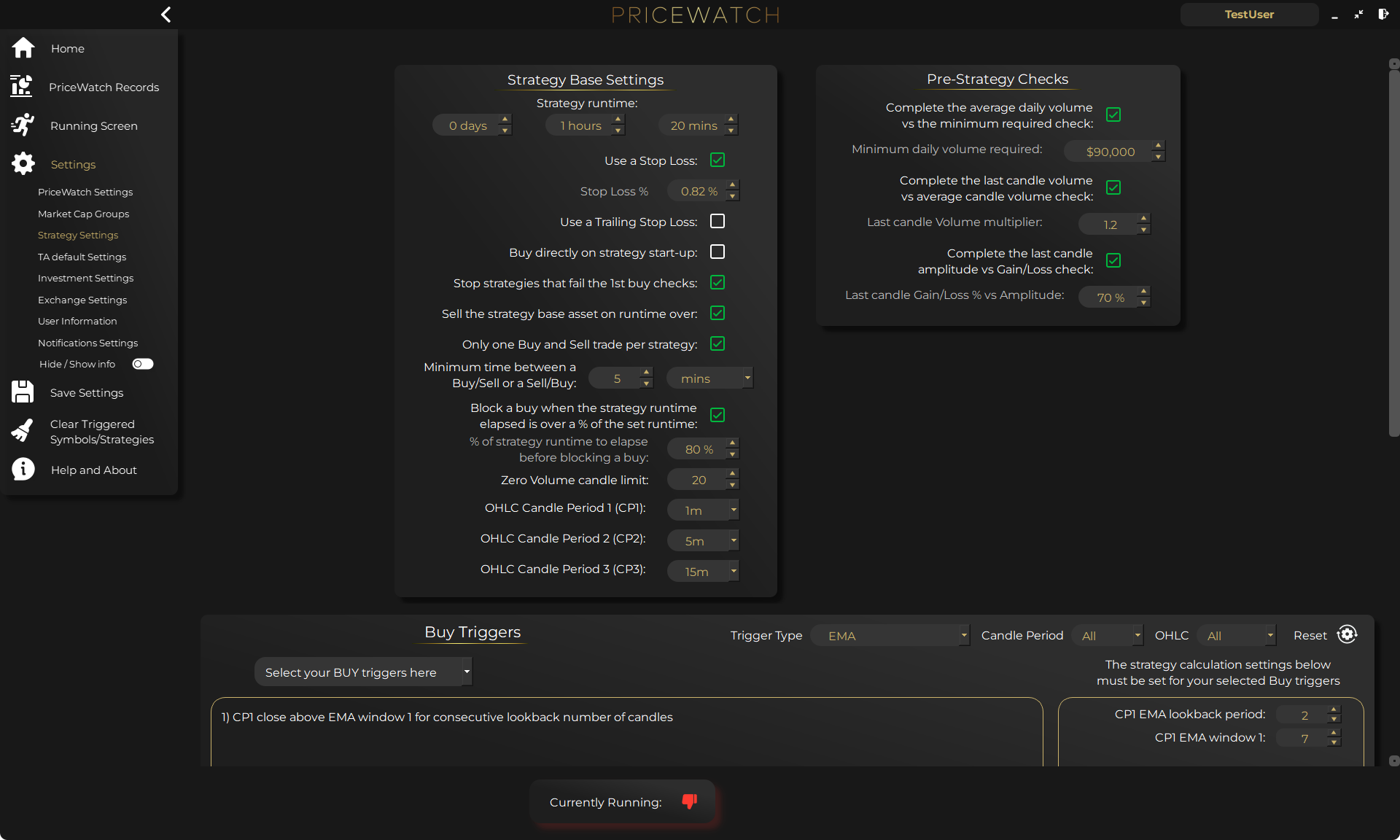
Inside PriceWatch, consistency testing should be boring on purpose. Leave the TEST setup unchanged for the whole sample window. If the setup depends on discovery, keep it in Market Monitoring rather than changing the structure mid-sample. Review the Live Feed during each session, then use the Records Screen with Test Trading and Market Monitoring filters so you are comparing like with like.
Keep short notes on whether stronger names still look strong for similar reasons, whether weak names are still weak for similar reasons, and whether the workflow's job still feels clear. If selected markets, exclusions, or Market Cap Group boundaries were part of the last tightening pass, leave those unchanged too so the sample stays fair.
What to log during the sample window
Keep the record simple. Note how many candidates surfaced, how many felt strong, weak, or unclear, why the weaker ones were rejected, how long the review took, and whether the setup's job still felt clear.
That gives you something more trustworthy than memory. You can compare whether the workflow is becoming more reviewable or whether it only felt better once.
What not to confuse with consistency
One unusually clean review cycle is not enough. Lower output volume by itself is not enough either, and simple familiarity is not proof. A workflow can feel better because you got used to it, not because it became more reliable.
The real question is whether the workflow stayed useful, not whether it became familiar or quieter.
When it is time to tighten again
Consistency testing is not a permanent freeze. It is a test period. If notes become vague again, stronger candidates stop separating clearly, review effort drifts back toward confusion, or the setup's job no longer feels stable, that is a sign to tighten again.
That is not failure. It just means the workflow needed another learning loop before it was ready for the next stage.
Why this matters before LIVE
A setup that improves once is interesting. A setup that stays useful over time is safer. Before LIVE, you want more than a workflow that occasionally looks promising. You want one that still makes sense after the excitement of the latest tweak wears off.
Consistency testing helps you decide whether to trust the setup's behaviour more, not whether profits are guaranteed. That is why it belongs between a cleaner TEST setup and any later LIVE-readiness decision.
Want to see the workflow in practice?
Start by reviewing the workflow in TEST mode
PriceWatch runs locally, helps you monitor broader markets, and gives you a way to review how the workflow behaves before deciding whether moving closer to LIVE use makes sense for you.
Prefer to keep researching first?
Keep learning before you decide
Get practical workflow ideas, product updates, and new articles by email, or keep reading through the blog at your own pace before you take the next step.
Keep the route moving
Best next pages from here
If this article solved only part of the problem, use the closest route below to keep moving through discovery, alerting, trust, and comparison intent without bouncing back to search.
Discovery route
Crypto market scanner
Use the fixed-intent landing page if you want the clearest explanation of scan-first market discovery.
Alerting route
Desktop crypto price tracker
Go here if your main intent is Windows-based monitoring, price alerts, and local desktop workflow.
Trust route
Cloud bot vs local software
Use this when the next question is privacy, key control, and where the workflow actually runs.
Comparison route
PriceWatch vs TradingView
Use the comparison path if you are weighing chart-first analysis against discovery-first monitoring.
Who this is for (and who it is not for)
Good fit if
- You have tightened a TEST Mode workflow and it now feels clearer, but you do not know whether it is actually stable.
- You want a fair way to judge whether stronger and weaker candidates are separating more reliably.
- You want a calmer bridge between setup refinement and any later LIVE decision.
Not a fit if
- You still cannot explain what the workflow is trying to surface.
- You want one unusually clean review cycle to count as proof.
- You want to keep changing settings constantly instead of testing a stable baseline.
FAQ
How many review cycles should I leave a workflow unchanged?
A practical guide is 5 to 10 review cycles, or roughly 2 weeks of your normal review cadence. The point is to look for a pattern, not a single good day.
What if the workflow feels mostly good but still imperfect?
That is usually the right time to test consistency. You are not waiting for perfection, only for a setup that is understandable enough to judge fairly.
Does quieter output automatically mean the workflow is better?
No. Lower output only helps if the workflow also becomes clearer, easier to review, and more aligned with its stated job.
What is the main success signal in the consistency phase?
Stable clarity. Review notes get more specific, stronger candidates are easier to recognise, and the workflow feels calmer across multiple cycles.