The failure usually happens earlier than traders think
A lot of traders assume the weak point in their workflow is alerting. They think they need faster notifications, cleaner conditions, or a better chart setup.
Sometimes that is true. But quite often the real failure happens earlier. The alert worked fine. The problem was that the market worth watching was never on the list in the first place.
That is a very different problem. It means the issue is not reaction speed. It is market coverage. And if that is the bottleneck, tuning the alert layer will only get you so far.
Two traders, two different bottlenecks
Some traders already know the markets they care about. They might work from a shortlist of 12 to 20 pairs, keep charts at the center of the process, and mainly want a cleaner way to react when conditions appear. For them, a chart-first alert workflow can be a very good fit.
Other traders have a different problem. They do not trust a small fixed list to catch enough of what matters. They keep noticing moves too late, spending too much time checking charts just to narrow the field, or feeling that the discovery part of the workflow is still messy.
That second trader does not mainly need a prettier alert layer. They need software that helps with coverage before chart review begins. That is where discovery-first monitoring starts to matter.
A simple self-diagnostic
If four or more of these sound familiar, your weak point is probably discovery, not alerts: you rely on the same familiar coins more than you want to admit, you often hear about a move after it is already underway, your watchlist is organized but still feels too small, you spend more time narrowing the field than analyzing the best setups, you can read charts well enough but struggle to surface candidates consistently, or your workflow depends heavily on memory, habit, or manually checking tabs.
If only one or two of those sound true, a chart-first alert stack may still be exactly right for you. This is not a universal verdict. It is a workflow diagnosis.
Why watchlists break in crypto
Watchlists are not bad. They just solve a narrower problem than many traders think. A watchlist helps you monitor what you already chose, which is useful when the selection step is already strong.
The trouble is that crypto is broad, noisy, and uneven. A small list can become a comfort blanket. It keeps you close to familiar names, but it can also hide the fact that your monitoring process is doing less discovery than you assume.
That is why some traders end up with a workflow that looks disciplined on the surface while still missing too much underneath. They have alerts, charts, and routines, but the real market-selection work is still happening manually and often inconsistently.
Where chart-first alerts are still the right answer
Some traders genuinely do not need broader discovery software. A chart-first alert workflow is often enough if you already trust your shortlist of markets, want visual chart review to stay central, mainly trade discretionary setups, prefer deciding what to watch before monitoring begins, and care more about chart context than broad market coverage.
That is why TradingView remains useful for a lot of people. It is good at helping traders track chosen markets, work visually, and react to defined conditions. If that is your bottleneck, there is no need to invent a bigger problem.
What changes when the problem is discovery
The moment the bottleneck shifts from reaction to coverage, the workflow has to change. Instead of asking, How do I get alerted on the markets I already picked? the question becomes, How do I narrow a much larger market down to the few things worth real attention?
That is a different operating model. It asks the software to do more of the first-pass filtering work, not the final decision-making. A lot of traders are still doing discovery by hand while pretending they have automated it.
If discovery is the weak point
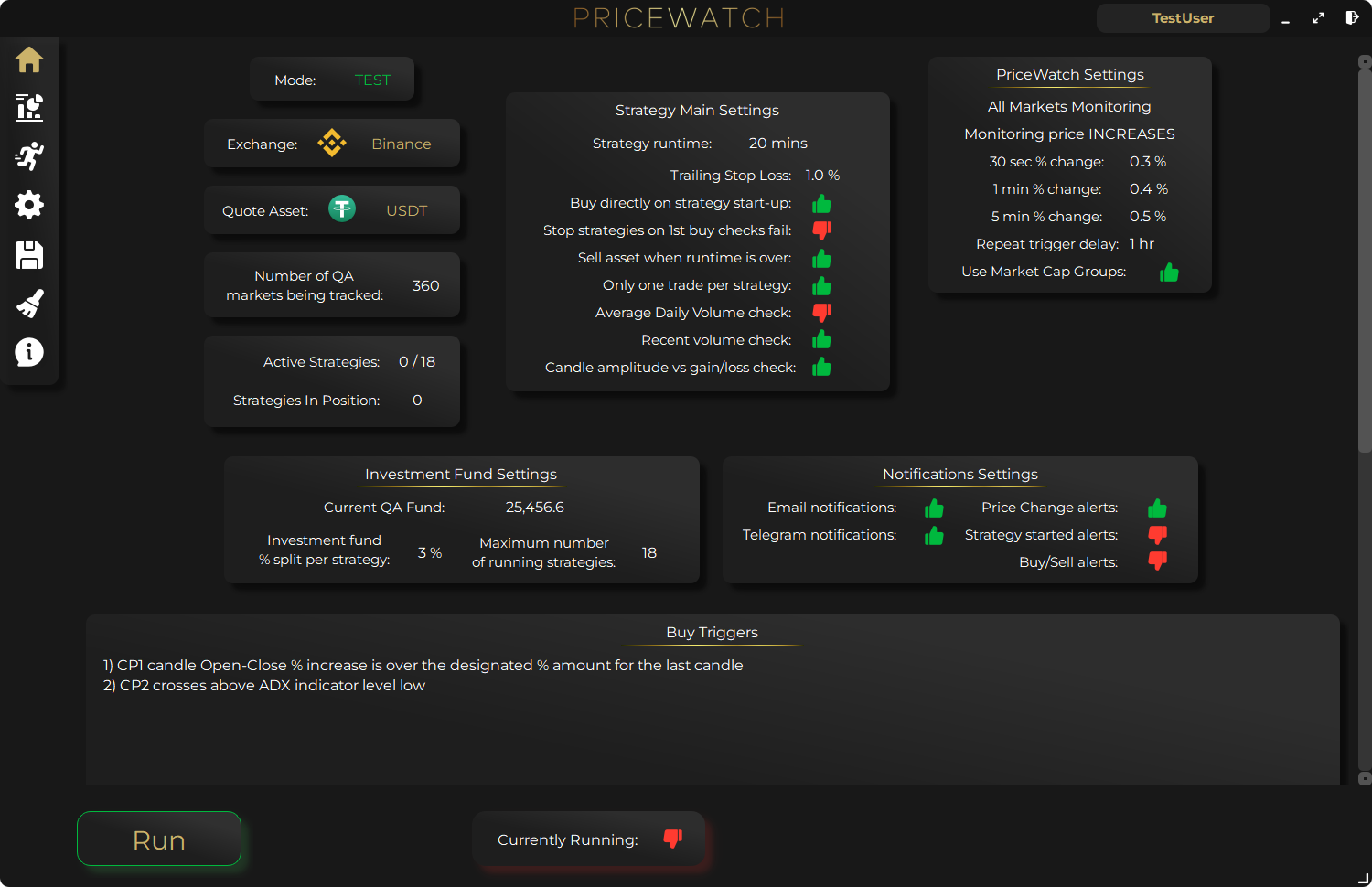
That is where PriceWatch becomes more relevant. It is built to monitor broadly, validate candidates with checks, keep the workflow in TEST Mode first, and only move closer to LIVE once the process makes sense.
What this looks like in PriceWatch
Based on current PriceWatch documentation, the product is built around desktop crypto market monitoring and automated trading workflows that run on the user's own Windows machine.
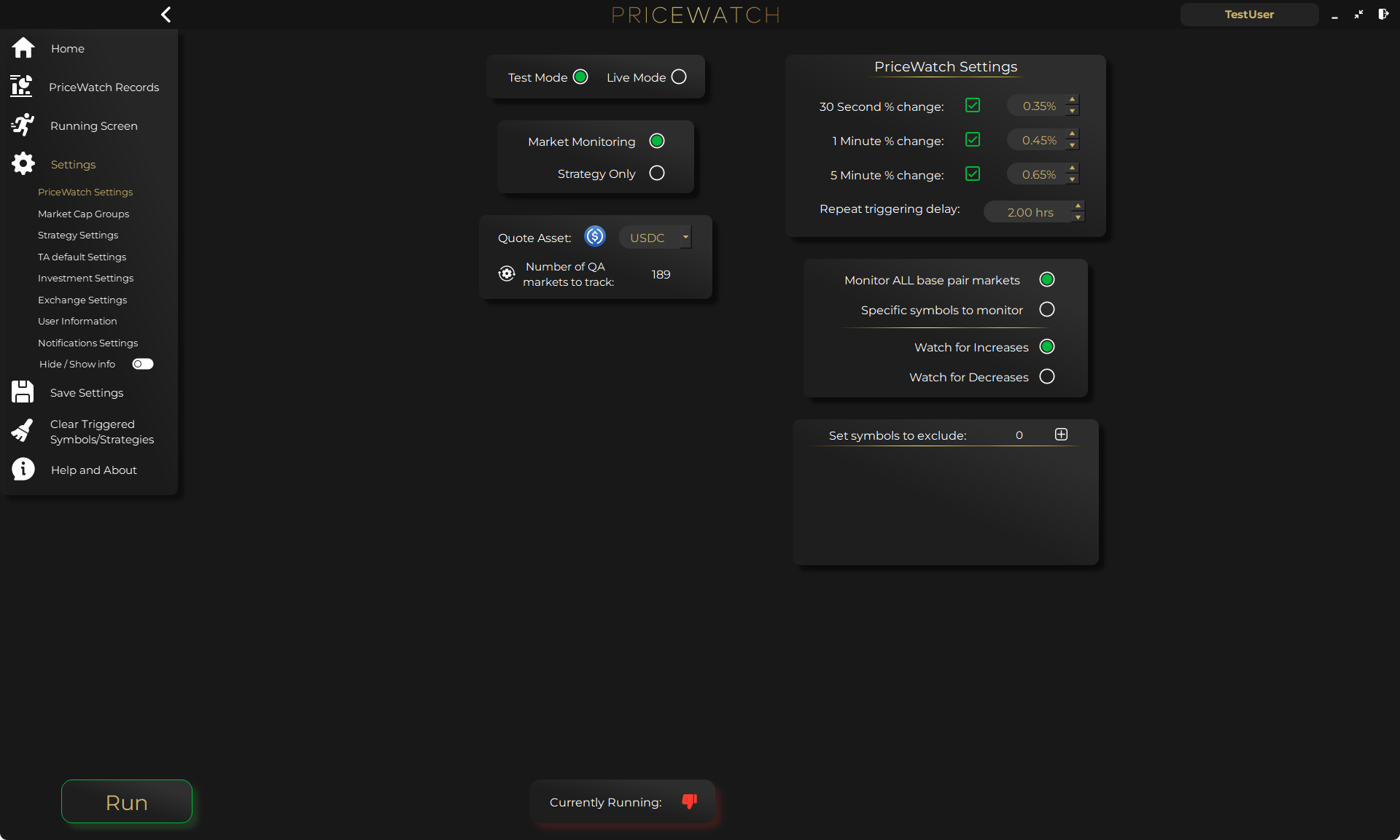
In Market Monitoring, PriceWatch can monitor all available markets for a chosen quote asset on one selected exchange at a time. Current product materials also describe price collection every 5 seconds, live price trigger checks every 15 seconds, and validation checks before a strategy is allowed to start.
That means the workflow is not just set an alert on a handful of preselected charts. It is closer to this: choose an exchange, choose a quote asset, define the trigger logic, let the monitoring layer surface candidates, filter weak conditions before strategy execution, and keep the workflow in TEST Mode until the behavior is stable enough for LIVE use.
The current docs describe three validation checks that can reject weak setups before strategy execution: Average Daily Volume Check, Candle Volume Multiplier Check, and Open-Close vs High-Low Ratio Check. That makes the system a better fit for traders whose problem is broad discovery plus workflow validation, not just chart monitoring.
A before-and-after example
In a manual watchlist workflow, a trader keeps 15 favorite USDT pairs on rotation. The setup may be clean, but anything outside that list is mostly invisible unless it shows up in social chatter, exchange rankings, or a manual scan session. In that workflow, the trader is still doing most of the discovery work themselves.
In a broader monitoring workflow, the trader chooses one exchange, chooses a quote asset, defines the conditions, and lets the monitoring layer watch the broader market for candidates that match the rule. Now the chart review happens after the first-pass surfacing, not before it.
That does not remove judgment. It changes where judgment gets applied. Instead of spending energy deciding what deserves a closer look, the trader spends more energy evaluating surfaced candidates and tightening the workflow.
Why TEST Mode matters here
Discovery software is only useful if you can inspect whether the workflow is surfacing the right kind of setups before real money is involved. That is why TEST Mode matters in this context.
PriceWatch's current materials describe TEST Mode as a way to validate a workflow with real market data before moving to LIVE Mode. That gives the trader room to answer the question that actually matters: Is this workflow finding the right kind of opportunities often enough, and filtering the wrong ones often enough, to deserve live risk?
That is more useful than treating discovery as a black box and hoping the alerts look impressive.
Who should care about this article most
This article is for traders who feel a bit trapped by their own routine. Not beginners who need a definition of chart alerts, and not pure discretionary traders who already know exactly what they want to watch.
It is for traders who have some process already, but keep noticing that the front end of the process is too manual. Strategy Steve usually wants a cleaner way to surface candidates and validate them before they reach live risk. Power-User Pete usually hates avoidable repetition and starts looking for a better operating model when manual narrowing becomes the daily drag.
When to stick with alerts, and when to change the workflow
Stay with alerts if your main issue is speed of reaction on markets you already trust. Rethink the workflow if your main issue is that too much of the market never reaches your decision layer at all.
That is the simplest version of the choice. You do not need a giant framework here. You just need to be honest about where your process keeps breaking.
Final takeaway
Some traders are missing alerts. A lot more are missing the market that should have triggered the alert.
If your shortlist is already strong, chart-first alerts may be all you need. If your shortlist is the weak link, refining alerts is not really solving the right problem.
In that case, the better move is often a discovery-first workflow that can monitor more of the market, apply validation, and let you test the process before trusting it with live execution. That is the lane where PriceWatch makes the strongest case, not as a replacement for charting software, but as a better answer to a different bottleneck.
Want to see the workflow in practice?
Start by reviewing the workflow in TEST mode
PriceWatch runs locally, helps you monitor broader markets, and gives you a way to review how the workflow behaves before deciding whether moving closer to LIVE use makes sense for you.
Prefer to keep researching first?
Keep learning before you decide
Get practical workflow ideas, product updates, and new articles by email, or keep reading through the blog at your own pace before you take the next step.
Keep the route moving
Best next pages from here
If this article solved only part of the problem, use the closest route below to keep moving through discovery, alerting, trust, and comparison intent without bouncing back to search.
Discovery route
Crypto market scanner
Use the fixed-intent landing page if you want the clearest explanation of scan-first market discovery.
Alerting route
Desktop crypto price tracker
Go here if your main intent is Windows-based monitoring, price alerts, and local desktop workflow.
Trust route
Cloud bot vs local software
Use this when the next question is privacy, key control, and where the workflow actually runs.
Comparison route
PriceWatch vs TradingView
Use the comparison path if you are weighing chart-first analysis against discovery-first monitoring.
Who this is for (and who it is not for)
Good fit if
- You keep missing moves because they never reached your watchlist in time.
- You want a cleaner way to narrow a broad crypto market before chart review starts.
- You are trying to diagnose whether your workflow problem is alerts, coverage, or manual narrowing.
Not a fit if
- You only trade a tiny fixed shortlist and do not want broader discovery.
- You want a generic "best platform" verdict instead of a workflow diagnosis.
- You expect software to remove trading risk or replace judgment.
FAQ
How do I know if my problem is alerts or discovery?
If you already trust your shortlist and mainly need faster reactions, alerts may be enough. If you keep missing moves because they never made it onto your list, your bottleneck is probably discovery.
Are watchlists still useful in crypto trading?
Yes. Watchlists are useful when the market-selection step is already strong. They become weaker when your process depends on manually curating too much of the market before monitoring even begins.
What does PriceWatch do differently for market discovery?
PriceWatch is built around broader market monitoring. Its product materials describe monitoring all available markets for a chosen quote asset on one selected exchange, applying trigger logic, validating candidates, and keeping the workflow in TEST Mode before LIVE use.
Does broader discovery replace chart review?
No. Broader discovery changes what reaches your decision layer. Chart review and judgment still matter after candidates are surfaced.
When is a chart-first alert workflow enough?
It is often enough when you already trust a defined shortlist, prefer discretionary review, and mainly need to react to conditions on markets you already follow closely.